

Can Animal-Assisted Therapy Help Children With Autism?
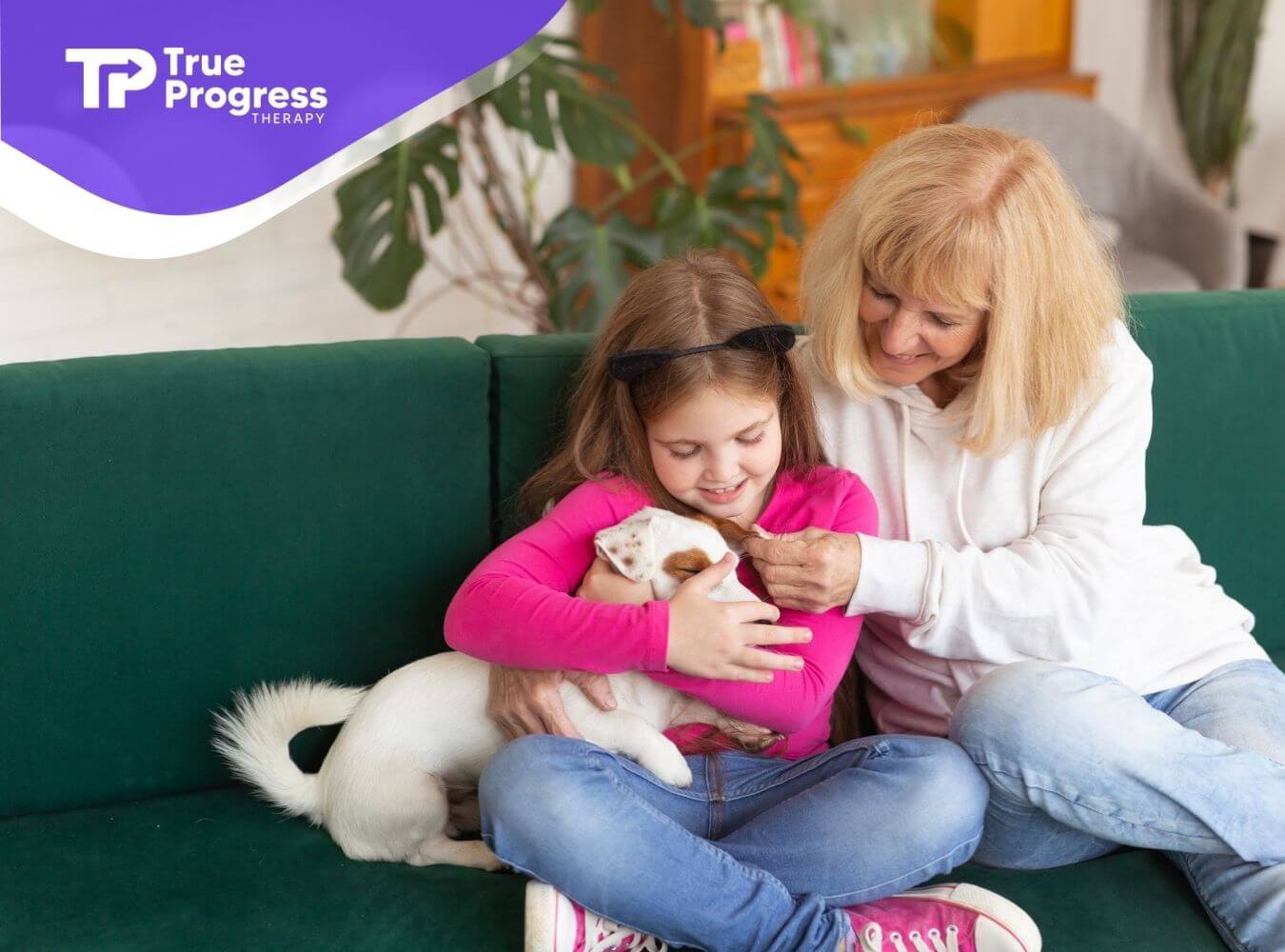
Many children with autism experience the world through unique sensory, social, and emotional perspectives. Because of that, traditional approaches to communication or social interaction don’t always feel natural right away. Over the years, we’ve seen how certain environments—or even certain activities—can make those interactions easier to start.
One approach that sometimes creates those opportunities is animal-assisted therapy for autism. In simple terms, this therapy involves structured interactions between children and trained animals to support developmental or behavioral goals.
Our team at True Progress Therapy works with families across New Jersey and Missouri through individualized autism services, including ABA parent training that helps caregivers support their child’s progress beyond therapy sessions.
We’ve occasionally seen how powerful these interactions can be. A child who hesitates to engage with unfamiliar adults might quietly sit next to a calm therapy dog within minutes. Another may begin giving simple directions to an animal—practicing communication skills without even realizing it.
Moments like these remind us that meaningful progress often starts with connection.
What Is Animal-Assisted Therapy for Autism?
Animal-assisted therapy (often called AAT) is a structured therapeutic approach where trained animals are incorporated into therapy sessions to help support specific developmental goals.
The keyword here is structured. This isn’t simply spending time with animals for comfort or entertainment. The interactions are guided by trained professionals who design activities that support learning, communication, and emotional regulation.
How Animal-Assisted Therapy Sessions Typically Work
In a typical animal-assisted therapy session, children may engage in activities such as:
- Giving simple commands to a therapy dog
- Grooming or caring for an animal
- Taking turns during play-based activities
- Practicing communication while interacting with the animal
Each activity is designed to support goals like:
- Improving social interaction
- Encouraging communication
- Building confidence
- Supporting emotional regulation
When these sessions are thoughtfully structured, animals can become powerful motivators for engagement.
Why Animal-Assisted Therapy Can Help Children With Autism
Many children with autism experience challenges with social communication or sensory processing. Animals can sometimes provide a bridge that makes those interactions feel less overwhelming.
Animals Reduce Social Pressure
Human social interactions are complex. Facial expressions, tone of voice, and rapid back-and-forth conversation can create pressure for children who process social cues differently.
Animals communicate in simpler ways. A wagging tail, relaxed posture, or gentle nudge can be easier to interpret than subtle human cues.
We’ve seen this dynamic play out in interesting ways during sessions. One child we worked with was extremely quiet around unfamiliar adults but immediately began talking when a therapy dog entered the room. He started describing the dog’s fur, asking questions about what it liked to eat, and eventually began directing the dog through simple commands.
The dog wasn’t just a comforting presence—it became a natural reason to communicate.
Animals Provide Calming Sensory Input
For some children, sensory regulation plays a major role in emotional comfort.
The repetitive motion of petting a dog or brushing a horse can provide calming sensory feedback. That kind of input can help some children feel more regulated and ready to participate in learning activities.
We once worked with a child who often struggled to transition into therapy sessions after school. On days when a therapy dog was present, the child would spend the first few minutes quietly brushing the dog’s fur. After that brief interaction, the transition into structured activities was noticeably smoother.
Small routines like this can make a big difference.
Animals Increase Motivation
Animals can also make learning feel more engaging.
A child who isn’t interested in practicing speech sounds might happily say “sit” or “come” while interacting with a dog. In those moments, communication becomes part of play instead of a task.
We often look for these natural opportunities because motivation is a powerful learning tool.
Types of Animal-Assisted Therapy Used for Autism
Different animals may be incorporated into therapy depending on the program and the goals being targeted.
Therapy Dogs
Therapy dogs are the most common animals used in animal-assisted therapy programs. They are highly trainable, comfortable around people, and able to respond to simple commands.
In sessions, therapy dogs may help children:
- Practice communication by giving commands
- Take turns during play activities
- Build comfort around social interaction
For some children, simply sitting near a calm dog helps reduce anxiety enough for them to engage more fully in activities.
Equine-Assisted Therapy
Equine-assisted therapy involves structured interactions with horses.
Children may participate in activities such as:
- Grooming horses
- Learning how to guide them
- Participating in supervised riding sessions
The rhythmic movement involved in horseback riding can also provide sensory input that supports balance and body awareness.
Small Animal Therapy
Some programs include smaller animals like rabbits or guinea pigs. These animals can be especially helpful for children who prefer quieter, slower-paced interactions.
Simple activities like feeding or gently holding a small animal can encourage responsibility, patience, and calm engagement.
How Animal-Assisted Therapy Can Support ABA Goals
Animal-assisted therapy does not replace evidence-based interventions such as Applied Behavior Analysis (ABA). Instead, it can sometimes complement these approaches by creating new opportunities for learning.
In ABA therapy, we focus on building meaningful skills such as:
- Communication
- Social interaction
- Emotional regulation
- Daily living skills
Animals can become helpful partners in those learning moments.
For example, a child might practice requesting by asking for a toy to throw for a dog. Another might work on turn-taking during a game involving the animal. Even simple routines—like asking for the dog’s brush—can become opportunities to strengthen communication.
We’ve found that when children feel motivated and comfortable, these learning opportunities often happen more naturally.
Important Considerations Before Trying Animal-Assisted Therapy
While animal-assisted therapy can be beneficial for many children, it’s not the right fit for everyone.
Several factors should always be considered:
- Allergies or medical concerns
- Sensory sensitivities
- Comfort level around animals
- The training and certification of the therapy animal
Equally important is ensuring that therapy sessions are guided by trained professionals who understand both child development and animal behavior.
Safety, structure, and supervision are essential for these programs to work effectively.
Supporting Children With Autism Through Individualized Care
Animal-assisted therapy highlights an important truth we see often in our work: children learn best when they feel safe, engaged, and motivated.
For some children, interacting with animals can open the door to communication, social interaction, and emotional regulation. For others, different supports may be more effective. Every child’s path is unique.
At True Progress Therapy, we focus on building individualized ABA services in New Jersey that meet each child where they are. Our team works closely with families through services such as in-home ABA therapy and practical ABA parent training so progress continues beyond therapy sessions.
If you’re exploring ways to support your child’s communication, behavior, or daily living skills, we’d be glad to help you understand what options might be the best fit for your family.
Is animal-assisted therapy effective for children with autism?
Animal-assisted therapy can be beneficial for some children with autism, particularly when it’s part of a structured therapeutic program. Interacting with trained animals may help encourage communication, reduce anxiety, and increase engagement during activities. While it isn’t a standalone treatment, it can complement evidence-based therapies by making learning experiences more motivating.
What is the difference between a therapy animal and a service animal?
A therapy animal is trained to participate in structured therapeutic or supportive activities with many different people, often in clinical or educational settings. A service animal, on the other hand, is specifically trained to assist one individual with a disability by performing certain tasks, such as guiding, alerting, or providing mobility support.
Are therapy dogs commonly used for autism support?
Yes, therapy dogs are the most commonly used animals in animal-assisted therapy programs. They are highly trainable and comfortable around children, which makes them well-suited for structured activities that encourage communication, interaction, and play.
Can animal-assisted therapy help with social skills?
For some children with autism, interacting with animals can make social practice feel less intimidating. Activities such as giving commands to a dog, taking turns during play, or describing an animal’s behavior can provide natural opportunities to practice communication and social interaction.
Who can provide animal-assisted therapy for autism?
Animal-assisted therapy should be guided by trained professionals who understand both therapeutic techniques and animal behavior. Programs often involve therapists, behavioral specialists, or clinicians working alongside certified therapy animals to ensure sessions are safe and structured around developmental goals.
Sources:
- https://pmc.ncbi.nlm.nih.gov/articles/PMC8907032/
- https://www.frontiersin.org/journals/veterinary-science/articles/10.3389/fvets.2024.1403527/full
- https://www.autismparentingmagazine.com/four-low-maintenance-pets/
- https://pubmed.ncbi.nlm.nih.gov/37313251/
- https://www.sciencedirect.com/science/article/pii/B978012801292500016X
Related Posts

What Happens During ABA Insurance Authorization in New Jersey?
Not sure what happens after you call? Walk through ABA insurance authorization in NJ, including benefits checks, treatment plans, insurer reviews, & approvals.
Read article
How Long Does It Take to Start ABA Therapy in New Jersey?
From diagnosis to the first in-home session, here is how long ABA therapy takes to start in NJ, plus the paperwork that keeps your family moving toward care.
Read article
What Happens in Your First ABA Therapy Session? A Parent’s Walkthrough
Parents almost always brace for something clinical. A room, a clipboard, a set of tasks their child will either pass or fail. Then I sit down on the floor with a bin of toys and spend an hour doing what looks, from the doorway, like nothing much at all Here is what happens in your […]
Read article