
How Soon Can You See Results from ABA Therapy?

When families begin working with our team at True Progress Therapy, one of the first questions we hear is:
“How long does it take for ABA to work?”
It’s rarely just curiosity. It’s usually coming from a place of exhaustion, hope, and uncertainty. Parents want to know when communication will improve. When transitions will feel smoother. When daily life will feel more predictable.
We always answer honestly:
Most families see measurable changes within 4–12 weeks of consistent ABA therapy.
Meaningful, functional progress develops over months.
Long-term independence unfolds gradually over time.
But timelines depend on multiple factors. Let’s walk through what actually influences how quickly ABA works — and what progress truly looks like.
How Long Does It Take for ABA to Work?
ABA (Applied Behavior Analysis) is individualized and data-driven. There is no universal timeline because no two learners start in the same place.
From our clinical experience at True Progress Therapy, we typically observe:
- Early engagement and cooperation improvements within the first month
- Communication growth within 2–3 months
- Reduction in challenging behaviors within 1–3 months (when consistently implemented)
- Noticeable functional gains within 6–12 months
The key word here is consistent.
ABA works through systematic teaching, reinforcement, repetition, and data analysis. Progress builds in layers.
What Happens in the First 30–90 Days of ABA Therapy
Before families see large-scale change, foundational work must happen. The early phase is critical.
Building Rapport and Reinforcement Systems
In the first few weeks, our team prioritizes:
- Pairing therapists with positive experiences
- Identifying highly motivating reinforcers
- Establishing instructional control
- Collecting baseline data
Without rapport and motivation, learning does not occur efficiently.
We recently supported a child who initially refused table activities and engaged in frequent avoidance behaviors. In the first month, we focused exclusively on pairing and reinforcement. By week four, he independently approached the therapy space — something that was not possible at intake.
That foundation made skill acquisition possible.
Establishing Foundational Learning Skills
Early goals in ABA often include:
- Imitation
- Attending to tasks
- Following simple instructions
- Functional communication
- Tolerating transitions
These may seem basic, but they are prerequisites for advanced learning.
One child we worked with had no consistent way to request items. Within eight weeks of structured communication teaching and reinforcement, she began independently requesting preferred items across settings.
That early communication shift dramatically reduced frustration-related behaviors.
What “Working” Means in ABA
A common misconception is that ABA “working” means eliminating all challenging behaviors.
That’s not how ethical ABA operates.
Our goal is to:
- Increase functional communication
- Replace unsafe behaviors with adaptive alternatives
- Build independence
- Improve quality of life
Progress is measured objectively.
How We Measure Progress
Every program we implement includes continuous data tracking. We measure:
- Frequency (how often a behavior occurs)
- Duration (how long it lasts)
- Latency (how quickly it begins)
- Prompt levels (independence vs assistance)
- Skill mastery percentages
For example:
- Tantrums decreasing from 6 per day to 2 per day over 8 weeks
- Independent requests increasing from 0 to 20 per session
- Prompt levels fading from full physical assistance to independent responding
This data-driven approach aligns with standards from the Behavior Analyst Certification Board (BACB) and peer-reviewed behavioral research.
When families ask whether ABA is working, we show them the graphs. Transparency builds trust.
Key Factors That Influence ABA Timelines
Many blogs oversimplify this topic. In reality, several variables affect how quickly ABA produces results.
Therapy Intensity
Research supports early intensive behavioral intervention for young children, often 20–40 hours per week when clinically appropriate.
Higher intensity can accelerate foundational skill development, particularly for learners requiring significant support.
However, intensity alone does not guarantee progress. Individualization and consistency matter more.
Consistency Across Environments
Skills must generalize beyond therapy sessions.
When caregivers participate in parent training and implement ABA strategies at home, progress accelerates.
We worked with a family who practiced functional communication for 10 minutes nightly. Within weeks, their child began independently requesting across home, therapy, and community settings.
Generalization is where ABA truly works.
Baseline Skill Profile
A learner with emerging joint attention and imitation skills may acquire language faster than one who requires foundational readiness instruction first.
Neither trajectory is better — they simply reflect different starting points.
Goal Complexity
Some goals show change more quickly than others.
- Behavior reduction may show measurable improvement within weeks.
- Social reciprocity and conversational skills may require sustained intervention over months or years.
ABA respects the complexity of human development.
A Realistic Month-by-Month ABA Timeline
While every child’s plan is individualized, here is a general framework we discuss with families.
Months 1–3: Foundation Phase
- Rapport building
- Reinforcement identification
- Baseline data collection
- Early communication teaching
- Initial behavior reduction strategies
Families often describe this phase as subtle but hopeful.
Months 3–6: Skill Acceleration Phase
- Increased independence
- Decreased prompt levels
- Clear data trends
- Improved transitions
- Generalization across settings
This is when families often say, “We’re seeing real change.”
Months 6–12: Functional Growth Phase
- Greater independence in daily routines
- Improved flexibility
- Expanded spontaneous communication
- Increased peer interaction
Grocery trips become manageable. Bedtime routines stabilize. Community outings feel less overwhelming.
Beyond 12 Months: Advanced Skill Development
- Social problem-solving
- Self-advocacy
- Academic readiness
- Transition planning
ABA shifts from stabilization to independence building.
Why Progress Sometimes Plateaus
Progress is not linear.
When we observe plateau periods, our team evaluates:
- Reinforcement strength
- Prompt dependency
- Treatment fidelity
- Environmental changes
- Skill complexity
We may adjust:
- Teaching methodology (DTT vs Natural Environment Teaching)
- Reinforcement schedules
- Task breakdown
- Goal sequencing
Plateaus are part of learning. They signal refinement, not failure.
Signs ABA Is Working
Families often ask what indicators to watch for.
Here are early and ongoing signs of progress:
- Reduced frequency or intensity of challenging behaviors
- Increased spontaneous communication
- Improved transition tolerance
- Greater independence in routines
- Faster acquisition of new skills
- Clear upward trends in data graphs
If these patterns are present, ABA is moving in the right direction.
From our experience at True Progress Therapy:
You will likely see small changes within weeks.
You will see meaningful functional progress within months.
Long-term independence develops gradually through structured, consistent support.
The most powerful transformations are rarely dramatic breakthroughs.
They are everyday victories:
- A child asking for help instead of crying.
- A calm morning routine.
- A successful playdate.
- A peaceful family dinner.
ABA works because it is systematic, individualized, and grounded in measurable data.
If you’re considering ABA and want to understand what a realistic timeline might look like for your child, starting with a comprehensive assessment provides clarity. At True Progress Therapy, we believe in clarity, collaboration, and measurable outcomes.
Our ABA services in New Jersey include:
- Personalized in-home ABA
- Supportive parent training
Schedule an assessment today and let’s create a realistic roadmap forward!
Frequently Asked Questions
How long should a child stay in ABA therapy?
Some children benefit from 1–2 years of structured support. Others require longer depending on developmental needs and goals.
Can ABA show results in three months?
Yes. Measurable improvements often appear within three months, especially in communication and behavior reduction. Long-term independence requires sustained intervention.
Does age impact how quickly ABA works?
Early intervention is associated with strong outcomes, but individuals of all ages can benefit when programming is individualized.
What if progress slows down?
Plateaus happen. Ethical providers reassess reinforcement, teaching strategies, and environmental variables to re-accelerate progress.
Sources:
- https://www.autismspeaks.org/applied-behavior-analysis
- https://pmc.ncbi.nlm.nih.gov/articles/PMC3196209/
- https://online.regiscollege.edu/blog/aba-therapy-examples
- https://www.autismspeaks.org/tool-kit-excerpt/helpful-strategies-promote-positive-behavior
- https://pmc.ncbi.nlm.nih.gov/articles/PMC5702301/
- https://www.autismparentingmagazine.com/autism-natural-reinforcement/
Related Posts
What Happens During ABA Insurance Authorization in New Jersey?
Not sure what happens after you call? Walk through ABA insurance authorization in NJ, including benefits checks, treatment plans, insurer reviews, & approvals.
Read article
How Long Does It Take to Start ABA Therapy in New Jersey?
From diagnosis to the first in-home session, here is how long ABA therapy takes to start in NJ, plus the paperwork that keeps your family moving toward care.
Read article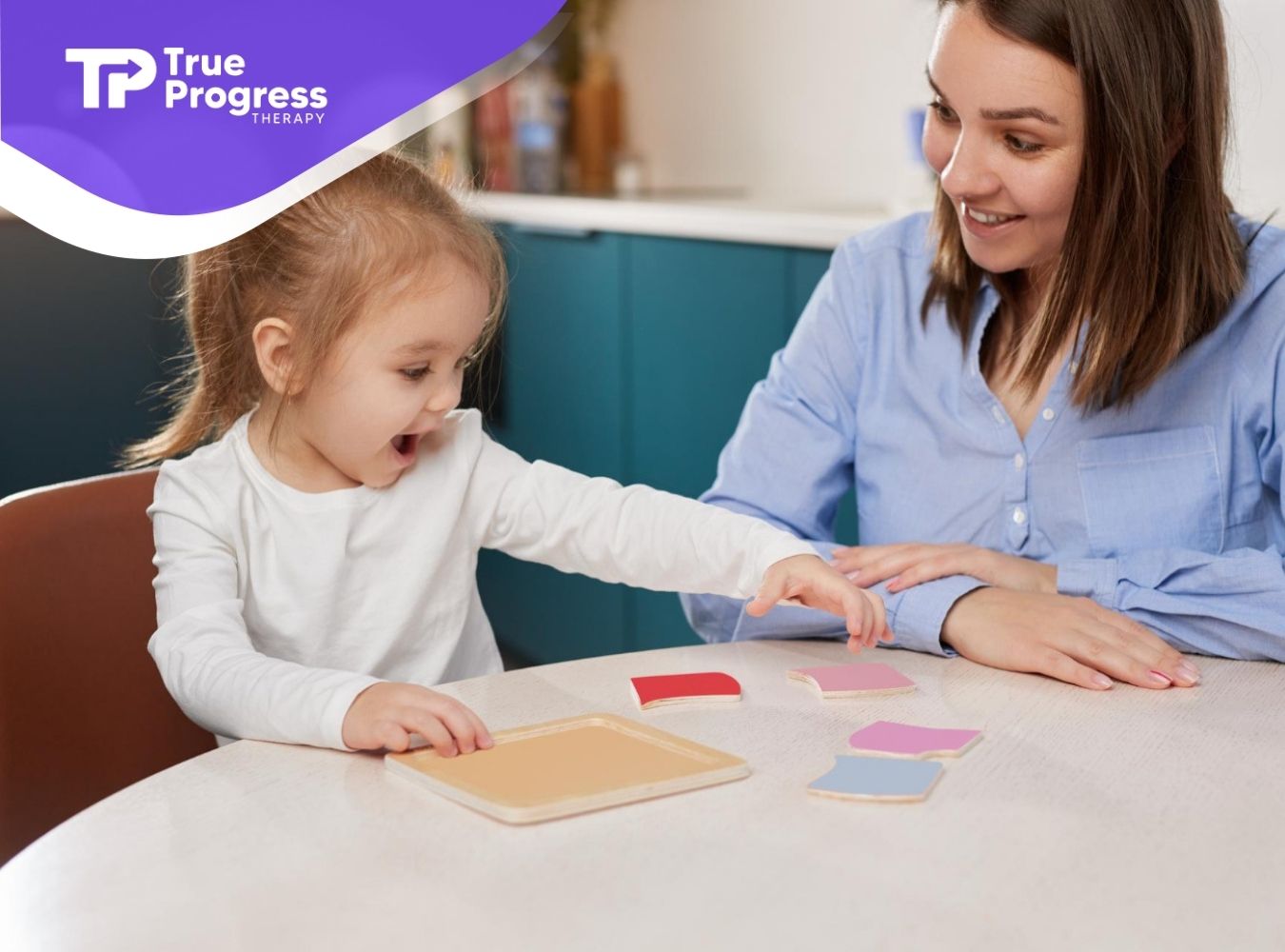
What Happens in Your First ABA Therapy Session? A Parent’s Walkthrough
Parents almost always brace for something clinical. A room, a clipboard, a set of tasks their child will either pass or fail. Then I sit down on the floor with a bin of toys and spend an hour doing what looks, from the doorway, like nothing much at all Here is what happens in your […]
Read article