

Newark Airport With an Autistic Child: TSA Cares Guide
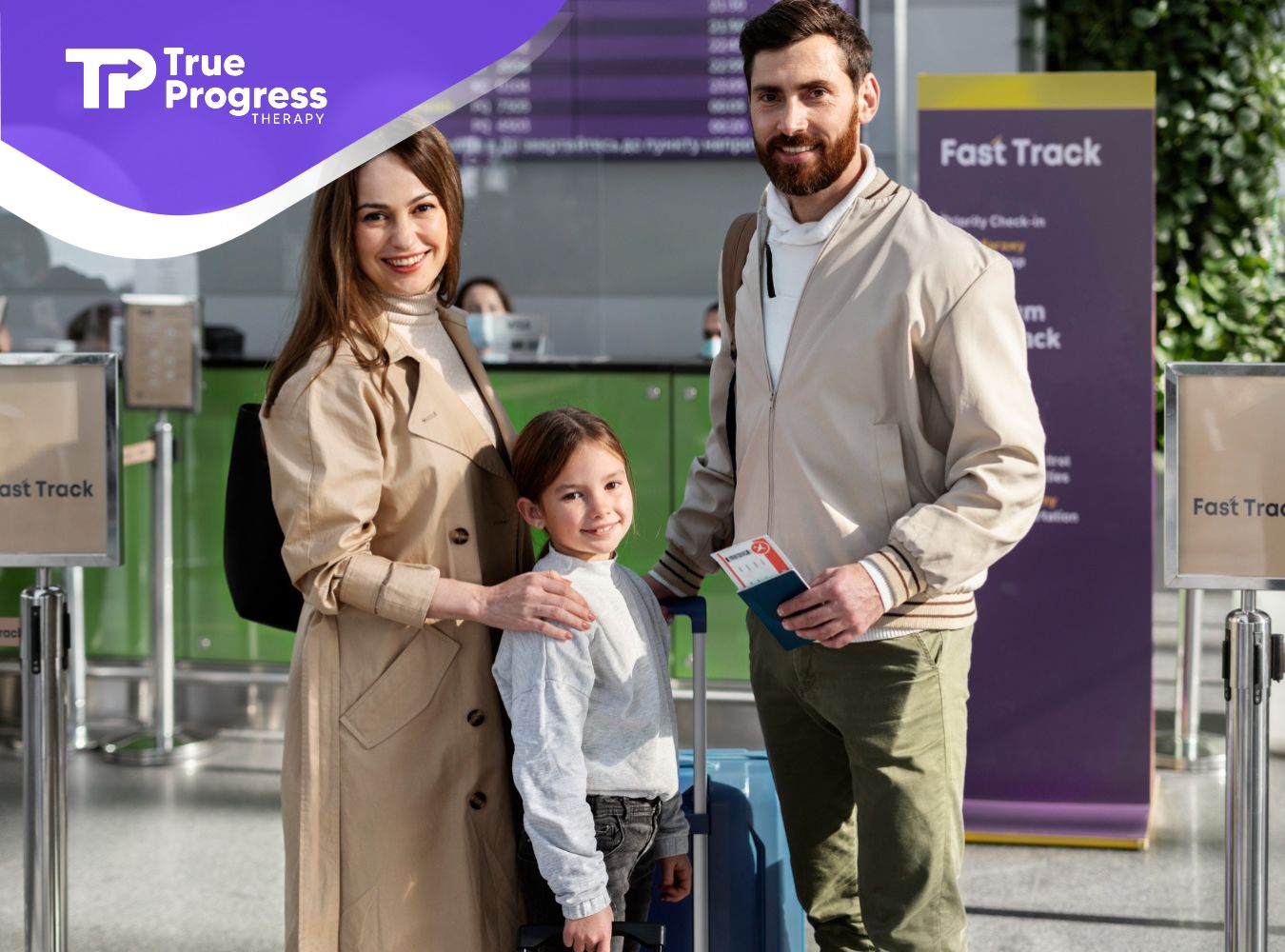
You can get extra support for an autistic child at Newark Liberty, and you can arrange most of it before you leave home. Call TSA Cares at least 72 hours before your flight, ask your airline about pre-boarding, and plan a stop at a Terminal A sensory room or a Sunflower lanyard pickup point.
Traveling through Newark Airport with an autistic child becomes far more predictable with those steps in place. At True Progress Therapy, I walk families through this prep, and the sections below put it in the order you will need it.
Planning Newark Airport Autism Travel Before You Leave Home
Most of the support at Newark Liberty works best when you set it up in advance. A simple countdown keeps the steps from piling up.
Two weeks out: lanyard and practice
EWR mails Hidden Disabilities Sunflower lanyards for free to domestic addresses. Requests must go in at least 14 days before travel, and arrival is not guaranteed, so ask early.
Use this window to start practicing at home. The U.S. Department of Transportation encourages families to look for airport rehearsal programs, which let travelers practice entering the airport, going through security, and boarding a plane. Availability varies by airport and season.
One week out: call your airline
Airlines may ask questions about your child's needs, but they cannot ask for specific medical details. Describe what is hard in plain terms, such as waiting in lines or loud announcements, and ask what accommodations they offer.
Per the DOT's guide for travelers with developmental disabilities, airlines must let passengers with disabilities who self-identify at the gate pre-board. Whether your whole family boards together depends on the airline's policy, so ask before travel day.
72 hours out: contact TSA Cares
TSA Cares is a helpline for travelers with disabilities and medical conditions. TSA asks you to contact them 72 hours before travel by calling (855) 787-2227 or submitting its online form.
Phone hours are 8 a.m. to 11 p.m. ET on weekdays and 9 a.m. to 8 p.m. ET on weekends and holidays.
Using TSA Cares and Passenger Support at Newark Liberty
TSA Cares can coordinate checkpoint support with the officers at your airport, and the level of help varies by location. Newark Liberty's Terminal A has built its sensory rooms around that support.
What to say when you call TSA Cares
Keep the call short and specific. Share:
- Your child's age and how they communicate
- What overwhelms them, such as noise, crowds, or unexpected touch
- What helps, such as headphones or a first-then card
- Your flight date, airline, and terminal
- Whether you want to use the Terminal A sensory room before security
How Terminal A pairs sensory rooms with a TSA Cares lane
According to the Port Authority, travelers can move from the pre-security sensory room to a dedicated TSA Cares screening lane staffed by specially trained personnel, then into the post-security sensory room. Ask about this when you call, since availability depends on your terminal and timing.
At the checkpoint
Tell the officer about your child's needs before screening begins, and ask for a Passenger Support Specialist if you want on-the-spot help. TSA says children will not be separated from their parents during screening, and modified procedures reduce the likelihood of a pat-down for children 12 and under.
TSA's notification card can help you communicate quietly, though it does not exempt anyone from screening. If a parent has TSA PreCheck, children 12 and under can use the PreCheck lane with them.
Sensory Rooms and Sunflower Lanyards at Newark Liberty
EWR lists its autism-related services on a dedicated page. Details can change, so check it before you fly.
Terminal A sensory rooms
Terminal A has two sensory rooms. One sits before security at the south end of the Departures level and is open 6 a.m. to 10 p.m. ET. The other is immediately after security and is open around the clock. Both are low-stimulation spaces for travelers who feel overwhelmed.
EWR's page lists its sensory rooms in Terminal A only. If you depart from Terminal B or C, ask whether a trip to Terminal A fits your timeline.
The Sunflower lanyard
The Hidden Disabilities Sunflower lanyard signals discreetly to staff that a traveler may need extra time, assistance, or understanding. Lanyards are free at the Welcome Centers on Level 1 in Terminals A, B, and C, and at the Terminal A sensory rooms.
Welcome Center hours are 6 a.m. to 10 p.m. ET in Terminal A and 8 a.m. to 10 p.m. ET in Terminals B and C. For questions, call +1 (973) 961-6000 and select option 5. Treat the lanyard as a signal to staff, and keep your airline and TSA Cares arrangements in place.
Practicing the Airport Routine at Home Before Your Flight
In my work, rehearsal is the most reliable travel prep because it turns a surprise into a routine. ABA gives us simple tools for it: break the trip into steps, show the steps visually, practice them in small pieces, and reinforce effort along the way.
Build a visual schedule and social story
List the trip in order: leave home, check in, security, wait at the gate, board, fly, land, collect bags. Use photos or simple drawings, and pair the schedule with a first-then board.
Autism New Jersey also suggests social stories and first-then boards when hands-on practice is not possible.
Rehearse security with a mock checkpoint
Set up a pretend line at home. Practice putting a backpack on a table, walking through a doorway, standing still with arms up for a few seconds, and waiting for a signal.
Keep each practice short and end on a win with praise or a favorite item. Our post on easier appointments shows how we prepare children for unfamiliar places and touch.
Plan reinforcers, breaks, and screen use
Pack a small set of preferred items and a break card your child can hand to you. Tablets help many children wait calmly, and our post on screen time covers how to set boundaries so a device supports travel without taking over.
If your child has an ABA team, ask your BCBA to add travel skills such as waiting, transitions, and following a visual schedule to their goals.
Ready to start the conversation? Complete our intake form and we will follow up about your child's needs.
Packing and Backup Plans for Flights Out of Newark
Delays and gate changes happen, and a backup plan keeps one surprise from becoming a meltdown. The DOT advises planning for sensory, dietary, and other needs in case your flight is delayed or changed.
What to pack
- Noise-canceling headphones
- Comfort items and a few preferred toys
- Familiar snacks (the DOT notes passengers may pack certain food items and medically required liquids)
- Your visual schedule and first-then board
- Chargers and a change of clothes
- TSA's notification card and a one-page summary of your child's needs
For a wider look at crowds and routine changes during busy travel seasons, see our sensory-friendly holiday tips.
What to do if plans change
Step away from the crowd, use the post-security sensory room if you are in Terminal A, and return to your visual schedule. If a checkpoint or airline issue comes up, ask for a TSA supervisor or Passenger Support Specialist, or for the airline's Complaint Resolution Official.
The DOT also notes that airlines cannot assume a safety risk based on a diagnosis alone.
Next Steps for Newark Airport Autism Travel
Traveling through Newark Airport with an autistic child takes a few advance calls and some rehearsal, and the steps are manageable when you take them in order. Request the lanyard two weeks out, call your airline a week out, contact TSA Cares 72 hours before, and practice throughout.
Flights can still bring surprises, and no plan removes every challenge. A prepared child and a prepared adult handle them better.
True Progress Therapy provides in-home ABA in New Jersey, including Newark, Elizabeth, Jersey City, Bayonne, and East Orange. Explore our ABA services:
Want help turning these travel steps into a practice plan for your child? Contact True Progress Therapy and our team can talk through how in-home ABA could build the skills your family needs for the next trip.
Frequently Asked Questions
Does Newark Airport have a sensory room for autistic children?
Yes. Newark Liberty's Terminal A has two sensory rooms, one before security at the south end of the Departures level and one immediately after security. Hours and locations can change, so check the EWR website before you travel.
How do I use TSA Cares at Newark Airport?
Call (855) 787-2227 or submit TSA's online form at least 72 hours before your flight. Share your child's needs, your flight details, and your terminal, and ask what checkpoint support is available at Newark.
How do I get a Sunflower lanyard at Newark Airport?
Lanyards are free at the Welcome Centers in Terminals A, B, and C and at the Terminal A sensory rooms. You can also request one by mail at least 14 days before travel, though arrival is not guaranteed.
Can my autistic child pre-board a flight?
Federal rules require airlines to let passengers with disabilities who self-identify at the gate pre-board. Whether the rest of your family boards with your child depends on the airline's policy, so ask before you travel.
Will TSA separate me from my autistic child at security?
TSA says children will not be separated from their parents or guardians during screening. Tell the officer about your child's needs before screening starts, and ask for a Passenger Support Specialist if you want extra help.
Sources
- Transportation Security Administration. (n.d.). I need special assistance during screening, whom can I contact before arriving to the airport? tsa.gov – I Need Special Assistance During Screening Whom Can I Contact
- Transportation Security Administration. (n.d.). Passenger support. tsa.gov – Passenger Support
- Transportation Security Administration. (2023). TSA tips for traveling with small children through the security checkpoint. tsa.gov – Tsa Tips Traveling Small Children Through Security Checkpoint
- U.S. Department of Transportation. (2015). Guide: Air travelers with developmental disabilities. transportation.gov – Developmental Disabilities Guide 0
- U.S. Department of Transportation. (2022). Airline passengers with disabilities bill of rights. transportation.gov – Disabilitybillofrights
- Port Authority of New York and New Jersey. (n.d.). Services for hidden disabilities. Newark Liberty International Airport. newarkairport.com – Hidden Disabilities Accessibility
- Anderson Center for Autism. (2025). Newark Airport opens second sensory room for special needs. andersoncenterforautism.org – Newark Airport Opens Second Sensory Room For Special Needs
- Autism New Jersey. (2022). Air travel and autism. autismnj.org – Air Travel And Autism
- The Arc. (n.d.). Wings for Autism. thearc.org – Travel
Related Posts

Autism Stigma in Immigrant Families: How to Start the Conversation
Worried what relatives will say about your child's autism? Learn how to start the conversation, answer cultural concerns, and find support for your family.
Read article
How to Find the Right Developmental Pediatrician in New Jersey for Your Child
Looking for a developmental pediatrician in NJ? Learn what to ask, how long the wait can be, what happens at the visit, and what to do while you wait.
Read article
Autistic Sleeping Positions: Are They Different From Typical Sleep?
Understanding Sleep Issues In Autism Children and adults on the autism spectrum often have unique sleep patterns and sensitivities. Research shows that autistic individuals are nearly twice as likely to face sleep disturbances compared with their neurotypical peers. This gap can create a ripple effe
Read article